MARINE ENGINEERING / SHIP PROPULSION SYSTEMS
Inside the Engines That Power the World’s Largest Ships
Follow the journey of energy from diesel combustion inside enormous cylinders to the rotating propellers that move cargo ships across the ocean.
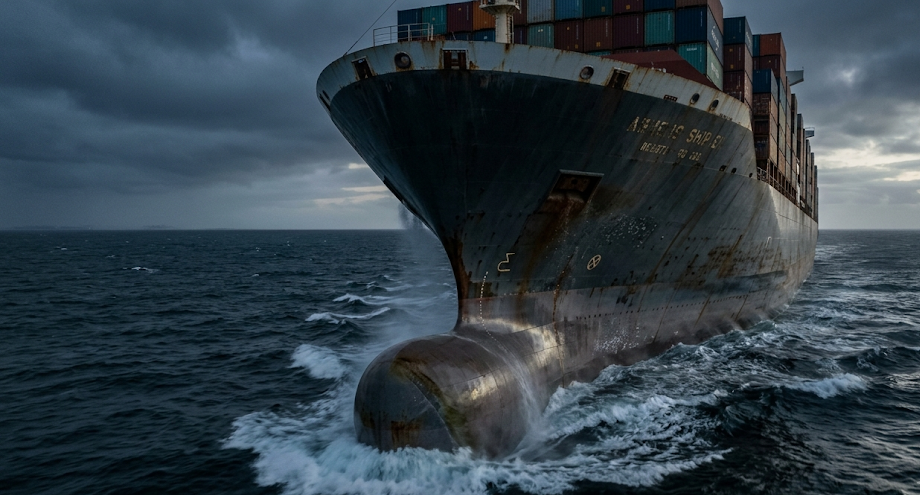
A fully loaded cargo ship can weigh tens of thousands of tons, yet a single enormous engine may provide the power needed to move it across an ocean. The machinery responsible is very different from the engines found in ordinary cars.
Large commercial ships often use powerful marine diesel engines designed to operate efficiently for extended periods. Some of the biggest vessels rely on slow-speed, two-stroke engines connected directly to a propeller shaft.
These engines do not move the ship by pushing against the water themselves. Instead, they convert energy stored in fuel into rotating mechanical power. That power turns a propeller, which accelerates water and generates the thrust needed to move the vessel.
Understanding this process reveals how combustion, mechanical engineering, fluid dynamics, and ship design work together to make modern ocean transportation possible.
Why Giant Ships Need Specialized Engines
Moving a large ship requires substantial power, but it also demands reliability and fuel efficiency. Ocean-going vessels may operate continuously for days or weeks, often far from repair facilities.
Marine engines must withstand heavy mechanical loads, maintain stable performance, and operate within demanding temperature and pressure conditions.
For many large merchant ships, slow-speed diesel engines provide an effective solution. These engines produce enormous torque at relatively low rotational speeds, allowing them to drive large propellers efficiently.
Unlike passenger cars, which typically operate over a wide range of engine speeds, many cargo ships spend long periods near a steady operating condition.
This makes efficiency at sustained loads especially important.
MARINE ENGINEERING PRINCIPLE
A Ship’s Engine Produces Rotation. The Propeller Converts That Rotation into Thrust.
The complete propulsion system must efficiently transfer energy from fuel combustion to the surrounding water.
The Basic Principle of Diesel Combustion
Marine diesel engines operate using compression ignition. Unlike a conventional gasoline engine, which normally uses spark plugs to ignite a fuel-air mixture, a diesel engine relies on high temperatures created by compressing air.
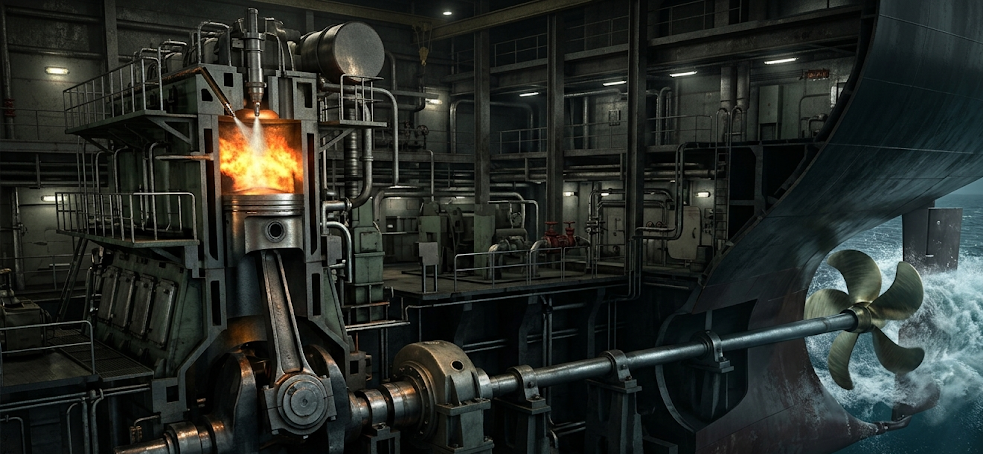
During operation, air enters the cylinder and is compressed by the rising piston. Compression raises the air temperature sufficiently for injected fuel to ignite.
Fuel is delivered into the hot compressed air through carefully controlled injection equipment. Combustion releases energy, increasing cylinder pressure and forcing the piston downward.
The piston is connected to a crankshaft through mechanical components that convert its movement into rotation.
This process repeats across multiple cylinders, producing the continuous mechanical output required for propulsion.
How a Two-Stroke Marine Diesel Engine Works
Many of the largest marine propulsion engines use a two-stroke operating cycle. In this arrangement, a complete power cycle occurs during one revolution of the crankshaft.
This differs from a conventional four-stroke engine, which completes its cycle over two crankshaft revolutions.
Large two-stroke marine engines commonly use uniflow scavenging, where fresh air enters through ports near the lower cylinder and exhaust gases leave through a valve at the top.
As the piston approaches the bottom of its travel, incoming air helps remove combustion gases and refill the cylinder.
The piston then moves upward, compressing the fresh air. Fuel injection and combustion occur near the top of the compression stroke, producing the next power stroke.
The precise timing of fuel injection, exhaust valve operation, and scavenging is essential for efficiency and reliable operation.
From Piston Movement to Crankshaft Rotation
The piston moves vertically inside the cylinder, but the propeller requires continuous rotational motion.
The crankshaft makes this conversion possible.
In large crosshead marine engines, the piston rod connects to a crosshead assembly. The crosshead guides the piston rod and transfers force through a connecting rod to the crankshaft.
This arrangement helps manage side forces and allows the cylinder and crankcase lubrication systems to be separated.
As combustion pushes the piston downward, the connecting rod applies force to the crankshaft, causing it to rotate.
Multiple cylinders deliver power at different points in the operating cycle, helping maintain smooth rotation.
ENERGY CONVERSION / ENGINE POWER PATH
Fuel Energy
↓
Combustion Pressure
↓
Piston Movement
↓
Crankshaft Rotation
↓
Propeller Shaft
↓
Propeller Thrust
Why Marine Engines Run at Low Speeds
Some large marine diesel engines operate at rotational speeds measured in only a few dozen to roughly one hundred revolutions per minute.
That is much slower than the engines used in most passenger vehicles.
Low rotational speed is useful because very large propellers can operate efficiently without turning at extremely high speeds.
Large propellers accelerate a substantial mass of water, producing the thrust required to move heavy ships.
Turning a propeller too quickly can contribute to cavitation, vibration, and efficiency losses.
Slow-speed engines are therefore well suited to direct-drive propulsion systems, where the crankshaft connects to the propeller shaft without a reduction gearbox.
Not every vessel uses this arrangement. Ferries, offshore vessels, and smaller ships may use medium-speed engines, gearboxes, electric propulsion, or other configurations.
The Role of the Propeller Shaft
The propeller shaft transfers rotational power from the engine toward the stern of the ship.
On a conventional direct-drive vessel, the shafting system includes couplings, bearings, and other components designed to support rotation and maintain alignment.
Because the shaft transmits enormous torque, its dimensions and materials must be selected carefully.
Misalignment or excessive vibration can damage bearings and other propulsion components.
Marine engineers monitor shaft condition, bearing temperatures, lubrication, and vibration to help identify developing problems.
The shaft ultimately turns the propeller, which interacts with the surrounding water to create thrust.
How a Propeller Pushes a Ship Forward
A ship’s propeller uses rotating blades shaped to produce a pressure difference as they move through water.
As the blades rotate, they accelerate water generally backward relative to the ship.
By Newton’s third law, the water exerts an opposing force on the propeller, creating forward thrust.
Propeller performance depends on blade shape, diameter, rotational speed, pitch, and the flow of water around the stern.
Large commercial ships often use propellers with several carefully designed blades.
Some vessels use fixed-pitch propellers, while others use controllable-pitch systems that can change blade angle to adjust thrust.
Efficient propulsion requires matching the propeller to the engine and the ship’s operating conditions.
What Does the Thrust Bearing Do?
The propeller creates an axial force along the shaft. That force must be transferred into the ship’s structure to move the vessel forward.
A thrust bearing performs this important task.
It supports the axial load generated by the propeller and transfers that force to the ship’s hull structure through its mounting arrangement.
Without a suitable thrust-bearing system, the shaft could not safely transmit the propeller’s pushing force into the vessel.
Some large engines incorporate the thrust bearing into the engine structure, while other propulsion arrangements use separate thrust-bearing installations.
This component illustrates an important distinction: the engine provides torque, while the propeller and thrust-bearing arrangement ultimately transmit the force that moves the ship.
How Marine Engines Maintain Efficiency
Large marine diesel engines are designed to convert a high proportion of fuel energy into useful mechanical work.
Several technologies help improve their performance.
Turbochargers use energy from exhaust gases to compress incoming air, increasing the amount of air available for combustion.
Charge-air coolers reduce the temperature of compressed intake air, improving its density.
Electronic control systems can adjust fuel injection and other operating parameters to improve performance under different loads.
Waste heat recovery systems may capture some energy from exhaust gases or cooling systems for other onboard uses.
Despite these improvements, substantial energy is still lost through exhaust heat, cooling, friction, and other processes.
Marine Diesel Engines vs Car Engines
| Feature | Large Marine Diesel Engine | Typical Passenger Car Engine |
|---|---|---|
| Primary Purpose | Sustained ship propulsion | Variable-speed road transportation |
| Typical Speed | Very low in slow-speed designs | Much higher rotational speeds |
| Engine Size | Can occupy multiple deck levels | Compact enough for a vehicle |
| Power Transmission | Often direct to propeller shaft | Through transmission to wheels |
| Operating Pattern | Long periods of steady operation | Frequent speed and load changes |
| Maintenance | Specialized onboard and shore support | Routine automotive service |
How Ships Control Speed and Direction
Ship speed can be adjusted by changing engine power and propeller rotational speed.
On vessels with fixed-pitch propellers, reversing thrust may require reversing the direction of propeller rotation. Some large direct-drive diesel engines are designed to run in reverse for this purpose.
Ships with controllable-pitch propellers can change blade pitch to produce different levels or directions of thrust without necessarily reversing engine rotation.
Other vessels use electric motors, gearboxes, or azimuthing propulsion units to control movement.
Steering is often accomplished through a rudder positioned in the propeller’s flow, although modern ships may use additional maneuvering systems.
Because large ships possess enormous momentum, changes in speed and direction take time and require careful planning.
Fuel Systems and Modern Environmental Requirements
Marine engines have historically operated on several petroleum-based fuels, including marine gas oil and residual fuel oils.
Fuel treatment equipment may be required to remove water and contaminants before fuel reaches the engine.
Modern ships must also comply with applicable international and regional emissions regulations.
These requirements have encouraged improvements in engine efficiency, exhaust treatment, and fuel selection.
Some newer ships use dual-fuel engines capable of operating with alternative fuels such as liquefied natural gas, while other technologies are being developed for lower-emission shipping.
Environmental performance depends on the entire fuel lifecycle, engine design, operating conditions, and emissions-control equipment.
Why Maintenance Is Essential at Sea
Marine propulsion systems operate under demanding conditions, making preventive maintenance essential.
Engineers monitor lubrication pressure, cooling temperatures, exhaust temperatures, fuel injection performance, and vibration.
Large engines also require inspections of pistons, cylinder liners, bearings, valves, and other components.
Lubricating oil helps reduce friction and wear, while cooling systems remove excess heat.
Because unexpected propulsion failures can create serious operational risks, ship operators use maintenance schedules and condition-monitoring systems to identify problems before they become critical.
Frequently Asked Questions
How does a diesel engine move a giant ship?
The engine converts fuel energy into crankshaft rotation, which turns a propeller that accelerates water backward and generates forward thrust.
Why do large ships use slow-speed diesel engines?
Slow-speed engines can produce substantial torque and drive large propellers efficiently without a reduction gearbox.
Do ship engines use spark plugs?
Conventional marine diesel engines use compression ignition rather than spark plugs.
What is the purpose of the propeller shaft?
It transfers rotational power from the engine or propulsion motor to the propeller.
What does a marine thrust bearing do?
It transfers the propeller’s axial thrust into the ship’s supporting structure.
Can a giant ship reverse its engine?
Some direct-drive marine diesel engines can reverse rotation. Other vessels use controllable-pitch propellers or alternative propulsion systems.
Are all large ships powered by diesel engines?
No. Although diesel propulsion is widespread, ships may also use diesel-electric, gas-turbine, nuclear, or other propulsion arrangements.
Final Thoughts
The movement of a giant ship begins with a carefully controlled combustion process inside an enormous marine engine.
Fuel energy becomes pressure, pressure drives pistons, and the crankshaft converts their movement into rotation.
That rotation travels through the propulsion shaft to the propeller, which accelerates water and generates thrust.
Supporting systems—including turbochargers, cooling equipment, lubrication systems, bearings, and electronic controls—help make this process reliable and efficient.
Although the machinery may be hidden deep inside a ship, its operation is fundamental to global maritime transportation.
Understanding how marine diesel engines work reveals the engineering behind the vessels that carry goods across the world’s oceans.

Marine Engineer, Naval Architect, and Maritime Hydrodynamics Specialist.