NAVAL ARCHITECTURE / SHIP DESIGN & HYDRODYNAMICS
The Hidden Engineering Beneath a Ship’s Bow
Discover why many large ships have rounded underwater projections—and how carefully designed hull shapes can reduce resistance, save fuel, and improve efficiency at sea.
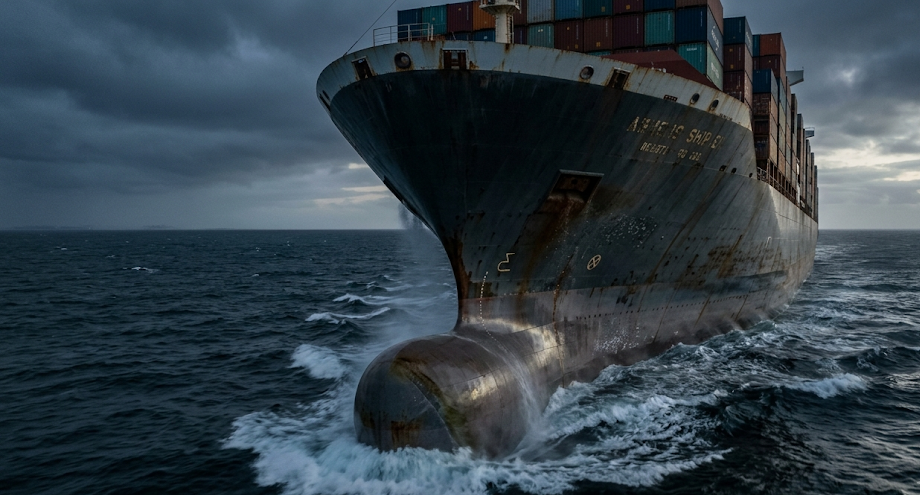
Look closely at the front of a large cargo ship, cruise ship, or ocean-going tanker, and you may notice an unusual rounded projection extending beneath the waterline.
This structure is called a bulbous bow.
At first glance, it might seem that adding a large rounded shape to the front of a ship would make it harder to move through water.
After all, a ship must push water aside as it travels.
Yet a properly designed bulbous bow can reduce the resistance a ship experiences at its intended operating speed.
The result can be lower engine power requirements and reduced fuel consumption.
The explanation involves wave formation, water pressure, hull geometry, and the complex interaction between a moving ship and the surrounding sea.
A bulbous bow does not simply make a ship more streamlined. Its main advantage comes from changing the waves generated by the hull.
What Is a Bulbous Bow?
A bulbous bow is a rounded or elongated underwater projection located near the front of a ship.
It extends forward from the main hull, usually below the waterline.
Its size and shape vary according to the vessel’s dimensions, speed, displacement, and operating conditions.
Some bulbs have a broad, rounded profile.
Others are more elongated or have shapes designed for particular hydrodynamic characteristics.
The bulb is not a separate engine or propulsion device.
It is part of the ship’s hull geometry.
Its purpose is to influence how water flows around the vessel and how waves develop as the ship moves forward.
Why Do Ships Experience Resistance in Water?
Moving a large ship through water requires energy.
The engines must generate enough thrust to overcome the resistance acting against the hull.
Several physical processes contribute to this resistance.
Frictional Resistance
Water moving along the hull creates frictional resistance because of its viscosity.
This resistance depends on factors such as wetted surface area, hull roughness, and vessel speed.
Marine growth, including algae and barnacles, can increase hull roughness and fuel consumption.
Wave-Making Resistance
As a ship moves, it disturbs the water surface and generates waves.
Creating these waves requires energy.
That energy comes from the ship’s propulsion system.
Wave-making resistance can be especially important for displacement ships operating at certain speeds.
Other Resistance Components
Ships also experience resistance related to pressure differences, appendages, air flow, and other effects.
The relative importance of these components depends on vessel type and operating conditions.
A bulbous bow is primarily intended to influence wave-making resistance, although it can also affect other aspects of hull flow.
How a Bulbous Bow Changes the Ship’s Waves
When a conventional ship bow moves through water, it creates a characteristic wave system.
The water surface rises and falls as pressure changes around the moving hull.
A bulbous bow creates its own wave pattern.
When the bulb is designed for the ship’s operating conditions, its waves can interact with the waves generated by the main bow.
In favorable circumstances, the two wave systems partially cancel one another.
This process is called destructive wave interference.
The result is a reduction in the energy carried away by waves.
Because less energy is lost through wave generation, the ship may require less propulsion power to maintain the same speed.
HYDRODYNAMIC PRINCIPLE / WAVE INTERFERENCE
Two Wave Systems Can Produce a Smaller Combined Wave.
A correctly designed bulbous bow changes the timing and shape of water-surface disturbances, reducing wave-making resistance under suitable conditions.
Why Bulbous Bows Work Best at Certain Speeds
Wave patterns depend strongly on ship speed.
As a vessel travels faster, the length and arrangement of its generated waves change.
The bulbous bow must be designed to interact favorably with the main hull’s wave system at the expected operating speed.
If the vessel travels substantially slower or faster than its design condition, the wave interaction may become less beneficial.
In some situations, a bulb can even increase total resistance.
This is one reason ship designers consider operating speed carefully before selecting a bulbous bow configuration.
A vessel intended for long voyages at relatively steady speeds may benefit more than a ship that frequently changes speed or operates under widely varying conditions.
The Importance of Hull Shape and Waterline Length
The bulbous bow is only one part of the overall hull design.
Naval architects must consider the entire underwater shape of the vessel.
Hull length, beam, draft, displacement, and the distribution of underwater volume all influence resistance.
Waterline length is particularly important for displacement vessels because it affects the relationship between ship speed and wave generation.
Longer hulls can often travel efficiently at higher speeds than shorter displacement hulls of similar proportions.
However, increasing hull length also changes structural requirements, construction costs, and wetted surface area.
Ship design therefore involves balancing many competing factors.
A bulbous bow is most effective when it is integrated into a carefully optimized hull rather than added as an isolated feature.
How Bulbous Bows Can Reduce Fuel Consumption
A ship’s engines consume fuel to generate propulsion power.
If hull resistance decreases, the vessel may need less power to maintain a given speed.
Lower power demand can reduce fuel consumption, depending on the propulsion system and operating conditions.
Even modest improvements in efficiency can become significant over long voyages.
Large commercial ships may travel thousands of nautical miles while carrying substantial cargo.
Small reductions in resistance can therefore produce meaningful operational savings over time.
However, there is no single fuel-saving percentage that applies to every bulbous bow.
Actual savings depend on vessel geometry, speed, loading, sea conditions, and the quality of the design.
SHIP EFFICIENCY / SIMPLIFIED RELATIONSHIP
Lower Hull Resistance → Lower Required Propulsion Power → Potential Fuel Savings
The relationship is influenced by propeller efficiency, engine characteristics, vessel speed, and operating conditions. A bulbous bow does not guarantee fuel savings in every situation.
Why Some Ships Do Not Have Bulbous Bows
Not every vessel benefits from a bulbous bow.
Small boats, low-speed vessels, and certain specialized ships may use other hull shapes.
For some vessels, frictional resistance is more important than the wave-making resistance a bulb is intended to reduce.
Adding a bulb also increases wetted surface area, which can increase frictional resistance.
Its construction may add cost and complexity.
For vessels operating at low speeds or with highly variable drafts, these disadvantages can outweigh the potential benefits.
Modern naval architects therefore evaluate whether a bulb is appropriate rather than assuming that every ship needs one.
How Loading and Draft Affect Bulbous Bow Performance
A ship’s draft is the vertical distance between the waterline and the lowest part of the hull.
Draft changes as cargo, fuel, ballast, and other loads are added or removed.
Because a bulbous bow is designed to operate at a particular position relative to the water surface, draft changes can affect its performance.
If the bulb is too deeply submerged or insufficiently submerged compared with its design condition, the intended wave interaction may be reduced.
This creates challenges for ships that operate under widely different loading conditions.
Naval architects may optimize the hull for a range of expected drafts rather than a single ideal condition.
The goal is to achieve good overall efficiency across the vessel’s actual operating profile.
Bulbous Bows on Different Types of Ships
| Vessel Type | Typical Operating Characteristics | Bulbous Bow Consideration |
|---|---|---|
| Container Ships | Long ocean voyages at planned service speeds | Potential efficiency gains at suitable speeds and drafts |
| Oil Tankers | Large displacement and varying cargo loads | Performance depends on speed and loading conditions |
| Cruise Ships | Passenger operations with planned routes | Hull optimization may include bulbous bow designs |
| Bulk Carriers | Heavy cargo and variable draft | Design must account for different loading conditions |
| Small Boats | Often lower speeds or different hull behavior | A bulb may offer limited benefit or increase resistance |
How Engineers Test Bulbous Bow Designs
Modern ship designers use several methods to evaluate hull performance.
One traditional approach involves testing scale models in towing tanks.
A model ship is pulled through water while researchers measure resistance and observe wave patterns.
These tests help engineers compare alternative hull shapes.
Computational fluid dynamics, commonly called CFD, is another important tool.
CFD uses numerical methods to simulate fluid flow around the hull.
Engineers can investigate pressure distribution, wave formation, and resistance under different operating conditions.
Computer simulations are often combined with physical experiments and operational data.
This helps designers evaluate the trade-offs between fuel efficiency, stability, construction requirements, and practical performance.
Can a Bulbous Bow Improve Stability?
The primary purpose of a conventional bulbous bow is usually to improve hydrodynamic efficiency rather than to act as a dedicated stability device.
However, changing the underwater hull shape can influence the vessel’s motion and interaction with waves.
These effects depend on the complete hull geometry and sea conditions.
Ship stability is governed by many factors, including hull form, center of gravity, displacement, and loading.
A bulbous bow alone should not be treated as a guarantee of better stability or safer operation.
Naval architects evaluate resistance, motions, and stability as related but distinct design considerations.
Why Modern Ship Designs Are Changing
Commercial shipping faces continuing pressure to improve fuel efficiency and reduce emissions.
One important operational change has been slow steaming, in which ships travel at lower speeds to reduce fuel consumption.
However, a bulbous bow optimized for a higher service speed may not perform as effectively when the vessel operates much more slowly.
Some operators have therefore considered hull modifications or redesigned bows to better match new operating conditions.
Modern ship designs increasingly focus on efficiency across realistic speed and loading ranges.
This may involve revised bulb shapes, alternative bow geometries, improved propellers, and other hydrodynamic improvements.
The best solution depends on the ship’s intended service rather than one universal design rule.
Common Misconceptions About Bulbous Bows
NAVAL ENGINEERING / MYTHS & FACTS
Myth: Bulbous bows simply cut through water like a knife.
Fact: Their main benefit comes from changing the wave system around the hull.
Myth: Every ship becomes more efficient with a bulbous bow.
Fact: Performance depends on speed, draft, hull geometry, and operating conditions.
Myth: A larger bulb always saves more fuel.
Fact: Excessive bulb size can increase resistance and reduce efficiency.
Myth: Bulbous bows eliminate waves.
Fact: They can reduce certain wave components but do not eliminate the ship’s entire wave system.
Myth: Bulbous bows work equally well at all speeds.
Fact: They are usually optimized for a particular range of operating conditions.
Frequently Asked Questions
What is the purpose of a bulbous bow?
A bulbous bow is designed primarily to modify wave formation around the hull, potentially reducing resistance and fuel consumption at suitable operating speeds.
Do bulbous bows reduce fuel consumption?
They can reduce fuel consumption when their hydrodynamic design matches the ship’s speed, draft, and operating conditions.
Why are bulbous bows underwater?
Their underwater position allows them to influence the pressure and wave patterns generated by the moving hull.
Do all large ships have bulbous bows?
No. Some ships use alternative bow designs because their speed, loading conditions, or operating requirements make a bulb less advantageous.
Can a bulbous bow increase drag?
Yes. At unsuitable speeds or drafts, a bulb may increase total resistance rather than reduce it.
How do engineers design bulbous bows?
Naval architects use hydrodynamic calculations, computational fluid dynamics, towing-tank experiments, and operating data to optimize bulb geometry.
Final Thoughts
Bulbous bows are an example of how ship design uses fluid dynamics to improve efficiency.
Rather than simply forcing water aside, a carefully designed bulb changes the waves generated by the main hull.
When these wave systems interact favorably, wave-making resistance can decrease.
Lower resistance may reduce the propulsion power needed to maintain speed, leading to potential fuel savings.
However, the benefits depend on vessel speed, loading conditions, hull geometry, and overall design quality.
Not every ship needs a bulbous bow, and modern naval architects increasingly optimize hulls for realistic operating conditions rather than a single ideal speed.
The rounded structure beneath the bow may look simple, but it represents a sophisticated application of hydrodynamics, engineering analysis, and practical maritime economics.

Marine Engineer, Naval Architect, and Maritime Hydrodynamics Specialist.